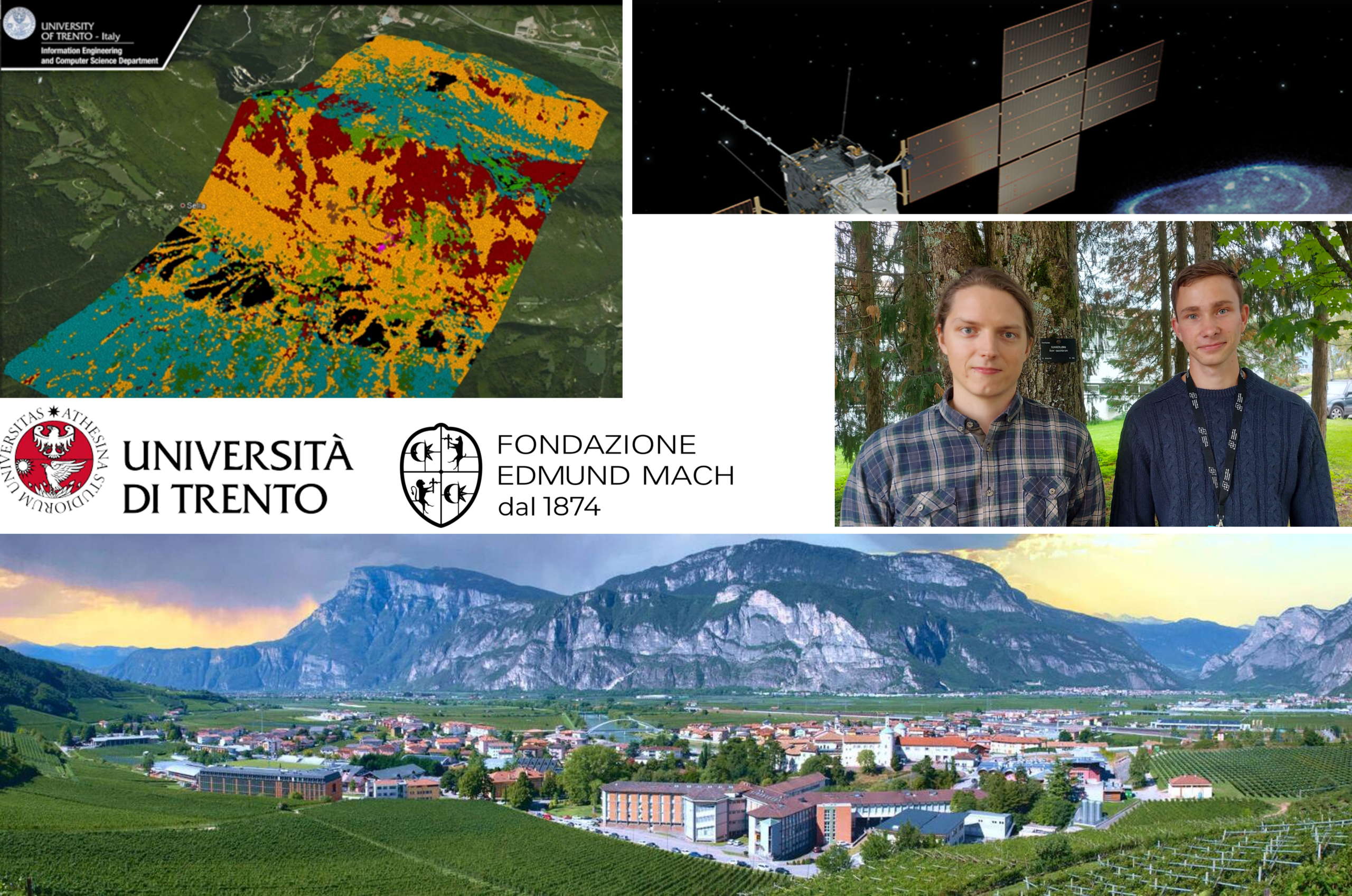
Håkon Næss Sandum and Julius Wold, both PhD candidates at NMBU conducted a 4 month research stay at the University of Trento and Fondazione Edmund Mach (FEM) in Italy during fall and winter 2025. The primary objectives of the visit were to strengthen existing collaborations between institutions, develop new professional networks, and receive methodological input relevant to their doctoral research within SmartForest on new methods in forest inventory.
The University of Trento Remote Sensing laboratory (RSlab), under Lorenzo Bruzone and Francesca Bovolo, has a diverse portfolio and expertise in remotely sensed data processing for terrestrial systems, and is also involved in Planetary Exploration. During the visit, RSlab contributed with expertise in data science and modelling. The PhD candidates brought their own datasets and research problems, and the close collaboration provided methodological feedback and engaged in technical discussions. The interaction offered substantial input on modelling strategies, including deep learning approaches and techniques for handling weak labels.
While in Italy, the candidates spent one day per week at Fondazione Edmund Mach (FEM). The research unit of forest ecology uses remote sensing data to estimate plant traits of forest and grassland vegetation. Activities range from leaf scale to regional scale, combining ground-based measurements with aerial and satellite platform data. The stay at FEM provided valuable exposure to a research environment specializing in forest mapping. Existing collaboration with FEM researcher Michele Dalponte facilitated access to the department and its research community, which enabled regular informal scientific discussions. Julius and Håkon also presented SmartForest and their research topics at a local seminar.
Despite differences in application areas—Trento’s work spans radar remote sensing and planetary observation, while FEM focuses primarily on forest research—the methodological dialogue proved highly relevant. Trento researchers contributed advanced modelling expertise, while the visiting candidates supplemented this with domain specific forestry knowledge.
The candidates emphasized that the extended physical stay was instrumental for effective network building. Regular, informal interaction—through shared workspace, daily routines, and collaborative problem-solving—created opportunities that would have been difficult to achieve through remote communication alone. This stay significantly lowered the threshold for renewed collaboration in areas of overlapping methodological interest.