
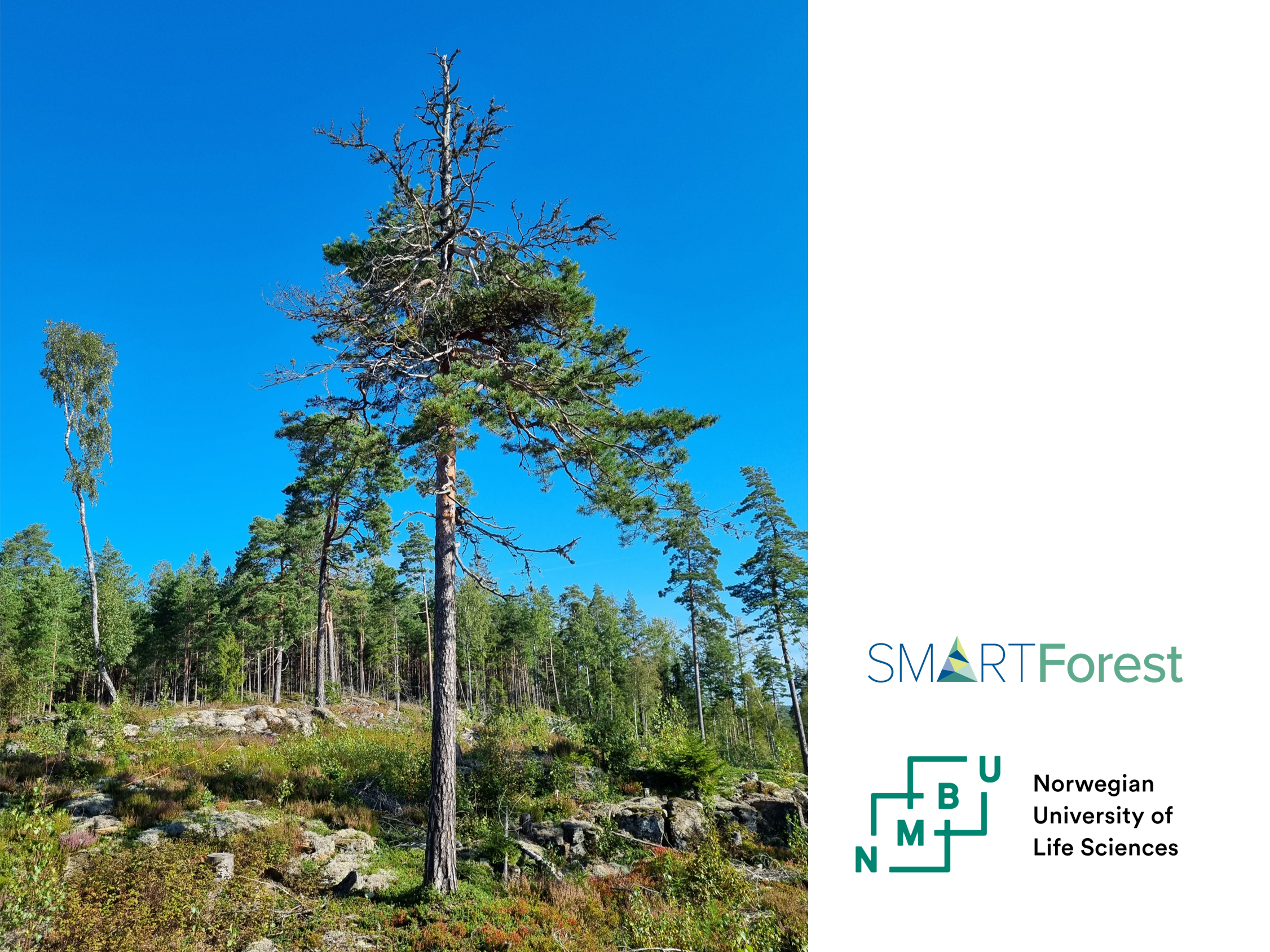
A new SmartForest article on Assessing airborne laser scanning and spectral data for species-specific retention tree information by Marie-Claude Jutras-Perreault, Terje Gobakken, and Hans Ole Ørka from NMBU was just published!
Clear-cut harvests and natural disturbances influence the forest ecosystem in very different ways. Retention trees are a practical way to keep old-forest structures in managed landscapes, and they are also a key reporting requirement under Norwegian certification standards (PEFC/FSC).
In a managed forest in southeast Norway, the authors tested how accurately retention trees can be detected, measured, and the species be identified using airborne laser scanning (ALS) at low and high point density—with and without spectral data—and whether off-site (“ex-situ”) reference data can reduce the need for new field measurements (“in situ”) in harvested stands.
The authors mapped retention trees using individual-tree segmentation from ALS (2 pulses/m² vs. ~100 pulses/m²), with optional spectral data. They predicted DBH and volume for detected trees using different reference datasets: in situ retention trees (n=630 across 27 stands), ex situ sample trees (n=1064), and ex situ annotated crown segments (n=150).
Take-home messages
- You can meet core mapping needs for retention trees using low-density ALS (2 pulses/m²) plus orthophotos—supporting more scalable certification reporting.
- For DBH/volume modelling, a small in-situ sample (~40 retention trees) is a good calibration compromise.
- For species work, ex-situ annotated segments can be a practical substitute for field-labelled trees.
- If a public, high-quality database of measured retention trees becomes available, in-situ sampling for diameter–height calibration may be avoidable
Link to the article https://link.springer.com/article/10.1007/s11676-026-02009-y
Image credit: Marie-Claude Jutras-Perreault, NMBU